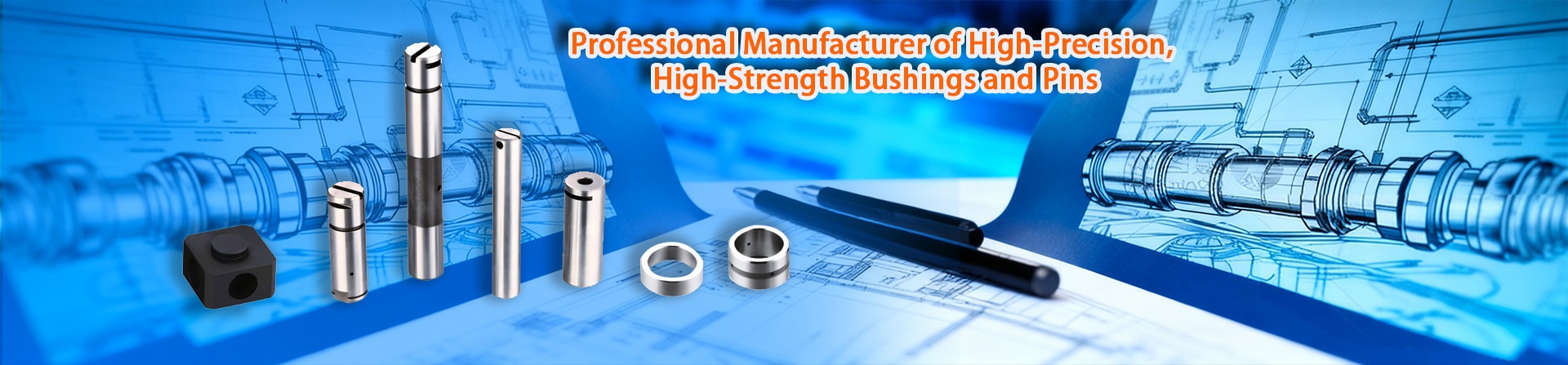
As a core connecting and force-transmitting component of mechanical equipment, axle pins are widely used in automotive chassis, agricultural machinery, special machine tools, engineering machinery and other fields. Their precision, strength and wear resistance directly determine the operational stability and service life of the entire machine. Addressing the core pain points in axle pin production, this solution integrates full-chain resources including material selection, process optimization, intelligent equipment and quality control, constructing a large-scale production system characterized by "precision and efficiency, controllable quality and optimized cost". It provides customers with integrated services from technical design to finished product delivery.
The current axle pin production field generally faces three core problems: first, low matching degree between materials and working conditions, leading to rapid product wear and easy fracture; second, difficulty in controlling processing precision, with high non-conformity rate of dimensional tolerances and geometric tolerances, affecting assembly compatibility; third, fragmented production processes and low automation, resulting in low efficiency and high costs. Especially in precision fields such as automobiles and high-end machine tools, the requirements for axle pins—including IT6-IT9 grade dimensional accuracy, HRC55-HRC62 surface hardness and Ra0.8-Ra1.6 surface roughness—further increase production difficulty.
-
Precision requirement: Key dimensional tolerance controlled within ±0.01mm, roundness and cylindricity error ≤0.01mm to meet precision assembly needs.
-
Performance requirement: Achieve "high rigidity and impact resistance" or "high wear resistance and fatigue resistance" characteristics according to load differences, with service life 30% longer than the industry average.
-
Efficiency requirement: Daily output of a single production line ≥5,000 pieces, defect rate (PPM) ≤50.
-
Customization requirement: Support customized production of axle pins with diameter range of φ5mm-φ80mm, different lengths and structures (stepped, through-slot, etc.).
Based on the load level and service environment of axle pins, a "material-working condition" matching matrix is established to ensure the optimal balance between performance and cost:
|
Application Scenarios
|
Recommended Materials
|
Core Performance Parameters
|
Adaptation Advantages
|
|
High-frequency rotating components (machine tool spindles, motor shafts)
|
GCr15 bearing steel
|
Surface hardness HRC60-66, tensile strength ≥1800MPa, uniform microstructure
|
High-purity and wear-resistant, reducing rotational friction loss and extending continuous operation time
|
|
Impact load scenarios (agricultural machinery suspension, engineering machinery pin sleeves)
|
20CrMnTi alloy structural steel
|
Surface hardness HRC58-62, core toughness ≥90J/cm2, carburized layer depth 0.8-1.2mm
|
"Hard outer and tough inner" characteristics, impact-resistant and not easy to fracture, adapting to bumpy working conditions
|
|
Heavy-load bearing components (automotive chassis, gearboxes)
|
42CrMo high-strength alloy steel
|
Hardness after quenching and tempering HRC28-44, yield strength ≥930MPa, fatigue strength ≥500MPa
|
High comprehensive mechanical properties, withstanding complex bending and torsion loads to ensure driving safety
|
|
Corrosive environments (marine machinery, food equipment)
|
304/316 stainless steel
|
Corrosion resistance ≥500h (neutral salt spray test), hardness HRC18-22
|
Rust and corrosion resistant, adapting to humid, acid and alkali environments
|
Adopting the mode of "automated assembly line + refined key processes", the closed-loop production from blanking to finished product is realized. The core processes are as follows:
-
Intelligent blanking: CNC band saws or laser cutting equipment are used for precise cutting of raw materials according to axle pin dimensions. The blanking precision is ±0.5mm, and the material utilization rate is increased to over 95%. For long-axis products, automatic feeding devices are equipped to reduce manual intervention.
-
Rough machining forming: CNC lathe clusters are used for basic forming processes such as cylindrical turning, step processing and chamfering. The double-spindle design realizes "one clamping and double-end processing", with dimensional tolerance controlled at ±0.05mm. The production efficiency is 40% higher than that of traditional lathes.
-
Directional heat treatment: Heat treatment processes are customized according to material characteristics. Vacuum quenching furnaces are mainly used to avoid oxidation and decarburization. Induction quenching is used for local strengthening of key stress-bearing surfaces. 42CrMo material achieves "strength-toughness" balance through quenching and tempering, and GCr15 steel undergoes cryogenic treatment (-196℃) to reduce retained austenite and improve dimensional stability.
-
Precision finishing: High-precision cylindrical grinders are used for final processing, equipped with online detection devices to feedback dimensional data in real time, ensuring roundness error ≤0.005mm and surface roughness reaching Ra0.8. For axle pins with slot and hole structures, five-axis machining centers are used for precise forming.
-
Surface treatment: According to rust prevention requirements, galvanizing (neutral salt spray ≥72h), phosphating (film thickness 5-8μm) or blackening treatment is selected. Automated spraying lines are used to ensure uniform coating, with adhesion meeting GB/T 9286-1998 Grade 1 standard.
-
Assembly assistance (optional): For pre-installed axle pins, servo presses are configured for precise press-fitting, with pressure precision ±5N and displacement error ±0.05mm. The press-fitting quality is monitored in real time through force-displacement curves to avoid interference or under-pressure problems.
-
Raw material inspection: Each batch of materials undergoes composition analysis (spectrometer detection) and mechanical property testing (tensile and impact tests). Unqualified materials are directly returned, and test reports are retained for traceability.
-
In-process inspection: Quality inspection posts are set at key nodes of rough machining, heat treatment and finishing. The mode of "first-piece inspection + patrol inspection (every 2 hours) + last-piece inspection" is adopted. SPC (Statistical Process Control) is used for key dimensions to promptly warn of process deviations.
-
Finished product inspection: Finished products must pass full-dimensional inspection, hardness testing and surface quality inspection. Sampling is conducted for fatigue life testing (≥1 million cycles without failure). Unqualified products are managed through a closed-loop process of "identification - isolation - analysis - improvement".
The MES (Manufacturing Execution System) is adopted to assign a unique traceability code to each axle pin, linking information such as raw material batch, processing equipment, operators and test data. The full life cycle data can be queried by scanning the code, meeting the requirements of ISO9001 quality management system and IATF16949 standard in the automotive industry.
Provide customized services including "demand analysis - structural design - sample trial production - mass production". Support optimizing axle pin structures according to customer drawings and working condition parameters, such as adding chamfers to prevent scratches and designing oil grooves to improve lubricity. The sample delivery cycle is ≤48 hours.
-
The product provides a 12-month warranty period. For quality problems occurring within the warranty period, free replacement is offered and logistics costs are borne.
-
A professional technical team is equipped to provide installation guidance and failure analysis services, assisting customers in optimizing assembly processes.
-
Establish customer files, conduct regular follow-up visits on usage, and proactively provide performance upgrade suggestions.
-
Demand docking (1-2 days): Clarify axle pin parameters, working condition requirements and output needs.
-
Scheme refinement (3 days): Output bill of materials, process flow chart and cost quotation.
-
Sample trial production (3-5 days): Complete sample production and provide test reports.
-
Mass production: After sample confirmation, arrange production according to the order quantity. The daily production capacity can be expanded to 10,000 pieces according to requirements.


.jpg)
 TEL:+86 576 81719318
  EMAIL:187300500@qq.com
 ADD:Building 46, Phase II, Chuangrong Industrial City, Yucheng Street, Yuhuan City, Zhejiang Province, China

 當前位置:
當前位置: